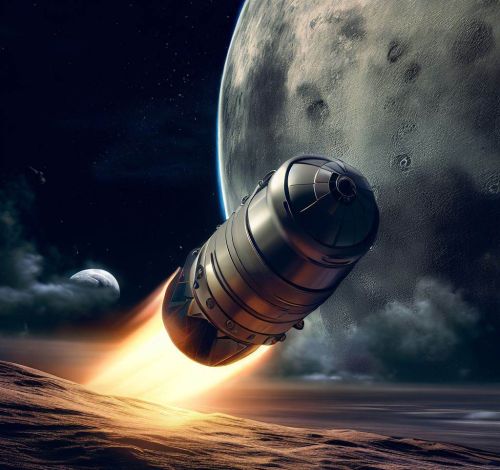
On Friday, August 10, 2023, Russia marked a significant milestone in space exploration by launching its first lunar mission in nearly five decades. Named Luna-25, this mission features a robotic lander with the aim of making a controlled landing on the Moon’s southern pole.
The historic launch took place at the Vostochny Cosmodrome in the Russian Far East, with Luna-25 expected to reach the lunar surface on August 21, 2023. Luna-25 serves as the inaugural mission in a series of lunar expeditions Russia has planned for the near future. The subsequent mission, Luna-26, is scheduled for 2024 and will involve a rover tasked with exploring the Moon’s southern pole.
Furthermore, Russia has outlined ambitious plans for a human mission to the Moon, slated for the 2030s. This underscores Russia’s enduring commitment to space exploration despite the challenges it faces, notably the ongoing conflict in Ukraine.
Russia’s Luna-25 launch also reflects a global resurgence of interest in lunar exploration. Other nations such as the United States, China, India, and Japan have similar lunar missions in their respective pipelines.
Several factors are driving this renewed lunar exploration fervor. The Moon is believed to harbor valuable resources, including water ice, which could be utilized for drinking water, fuel production, and more. Additionally, the Moon holds strategic importance as a vital transportation corridor within the Earth-Moon system.
Scientific curiosity is another driving force. The Moon, being the only celestial body humans have visited, offers a unique opportunity to study planetary formation and evolution, shedding light not only on our own planet but also on the broader processes shaping our solar system.
The launch of Luna-25 reaffirms Russia’s stature as a significant player in space exploration. It will be fascinating to observe how Russia’s space program evolves and contributes to our expanding understanding of the cosmos in the years to come.