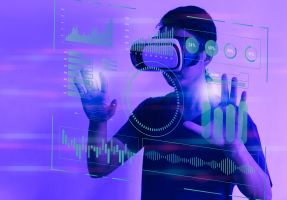
One potential application of combining angular momentum with holograms and metasurfaces is in the field of virtual reality and augmented reality. By using the angular momentum of a user’s movements, such as the rotation of their head or hand, to manipulate a hologram or metasurface, it is possible to create more immersive and interactive VR and AR experiences.
A user could rotate their hand to “grab” and rotate a holographic object, or spin their head to move around and explore a 3D virtual environment. The use of angular momentum could also be used to create more natural and intuitive interfaces for VR and AR applications, making them more accessible to a wider range of users.
Other potential application could be in the field of microscopy and imaging. By applying angular momentum to the holographic or metasurface elements used in microscopy, it may also be possible to manipulate the imaging process and extract more information from the sample being imaged. This could lead to improvements in the resolution and sensitivity of microscopy techniques, enabling researchers to study biological and physical systems in more detail.
Combining angular momentum with holograms and metasurfaces opens up new possibilities for creating innovative applications in a range of fields, from entertainment and gaming to scientific research and medical imaging.